
Effect Archive
76 psychological effects
Errors of judgement aren’t random. They lean in fixed directions, and those directions were written into the experimental record a long time ago.
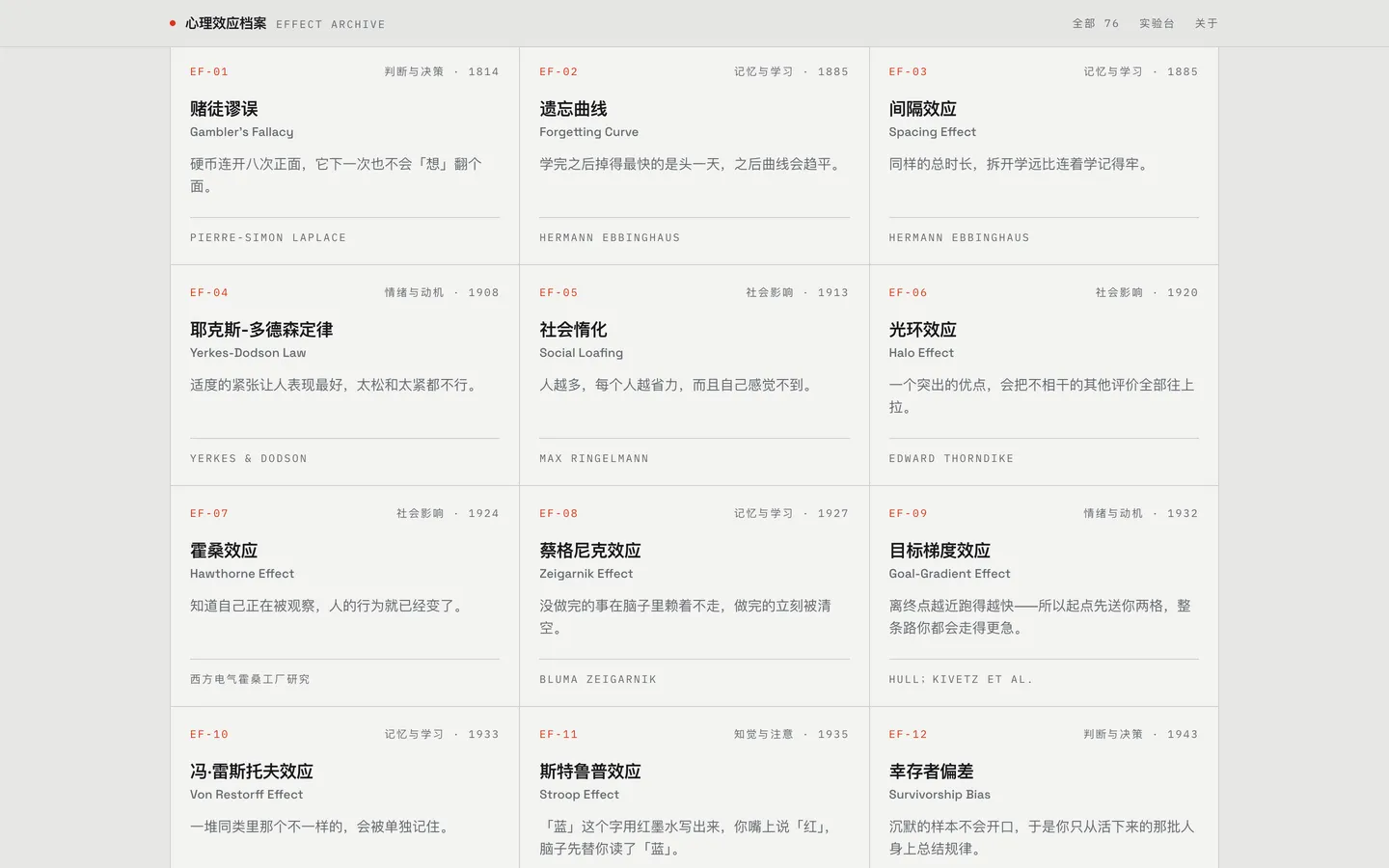
This is an archive of 76 of them, spanning 1814 to 2011. Each entry states three things clearly: what the original experiment actually did, what the effect looks like in your own life, and what specifically to do about it.
Take the test first, read the definition after
The first screen explains nothing. It asks you to spin a wheel.
The wheel gives you a random number, then asks a question with no connection to it — what percentage of UN member states are African. That’s a reproduction of Tversky and Kahneman’s 1974 experiment: they spun a rigged wheel in front of subjects (it only ever stopped on 10 or 65), and the group that saw 10 gave a median answer of 25% while the group that saw 65 said 45%. Everyone watched the number come from a random wheel. Everyone was dragged twenty percentage points by it anyway.
Anchoring doesn’t need you to believe it, only to see it. Reading that sentence does less than falling for it once, so it comes before every definition on the site.
How an entry is laid out
Catalogue number, field, year and originator sit on the top line — this is an archive, not an explainer, so the metadata comes first.
The body is always five sections: definition, the original study, how it shows up in life, what to do, related effects. The study section is the point. Most popular write-ups give you only the conclusion, and conclusions detached from their experimental conditions frequently don’t hold. Here you get what was done, what the sample looked like and how large the difference was, so you can judge how far it generalises yourself.
A rule the project sets for itself
The entry count is always derived from totalCount on the page — never hard-coded.
That’s written into the project’s README, for a practical reason. On a site about “76 effects”, that number gets written into the title, the navigation, the meta description and the about page, and the day a 77th arrives one or two of them will be missed. Deriving them all from the length of a single array removes the possibility.
How it’s built
Next.js 16 App Router, Tailwind v4 and TypeScript — fully static, no database, no API.
Content lives in src/data/effects/, split by category, with an aggregation layer handling year-ordering, numbering and search. The metadata for each interactive lab carries a mandatory caveat field: any reproduction has to state exactly how it differs from the original experiment, and it isn’t allowed to be empty.


- Launched
- 2026
- My role
- Solo developer
- Built with
- Next.jsTypeScriptTailwind